Women entrepreneurs in Taiwan have been increasing in number in recent years. They demonstrate distinctive ways of operating their businesses and hold different perspectives on how success is defined. However, throughout their entrepreneurial journeys, many still face gender bias, difficulties in accessing resources and funding, balancing family responsibilities. These obstacles have yet to be systematically explored and documented.
Her Attitude Taiwan Women Entrepreneurs Empowerment Association partnered with The Social Investment Consultancy(TSIC ) conduct the 2025 Taiwan Women Entrepreneurship Survey, aiming to gain a comprehensive understanding of the current landscape of women entrepreneurs in Taiwan. The survey not only examines industry types, enterprise scale, and operational performance, but also explores women entrepreneurs’ values, lifestyles, and the challenges they face in relation to gender roles.
We hope this study will highlight the diversity and genuine needs of women entrepreneurs, offering valuable insights for policymakers, HR teams, and sustainability departments to build more inclusive support systems. We seek to bring together like-minded partners in shaping an ecosystem that embraces innovation, social impact, and gender inclusivity.
This study uses both quantitative and qualitative methods.
targeting women entrepreneurs from across Taiwan.
A total of 400 valid questionnaires were collected
and in-depth interviews were conducted with 8 experienced women entrepreneurs.
Covers a diverse range of industries and businesses of varying sizes.
Participant Profile
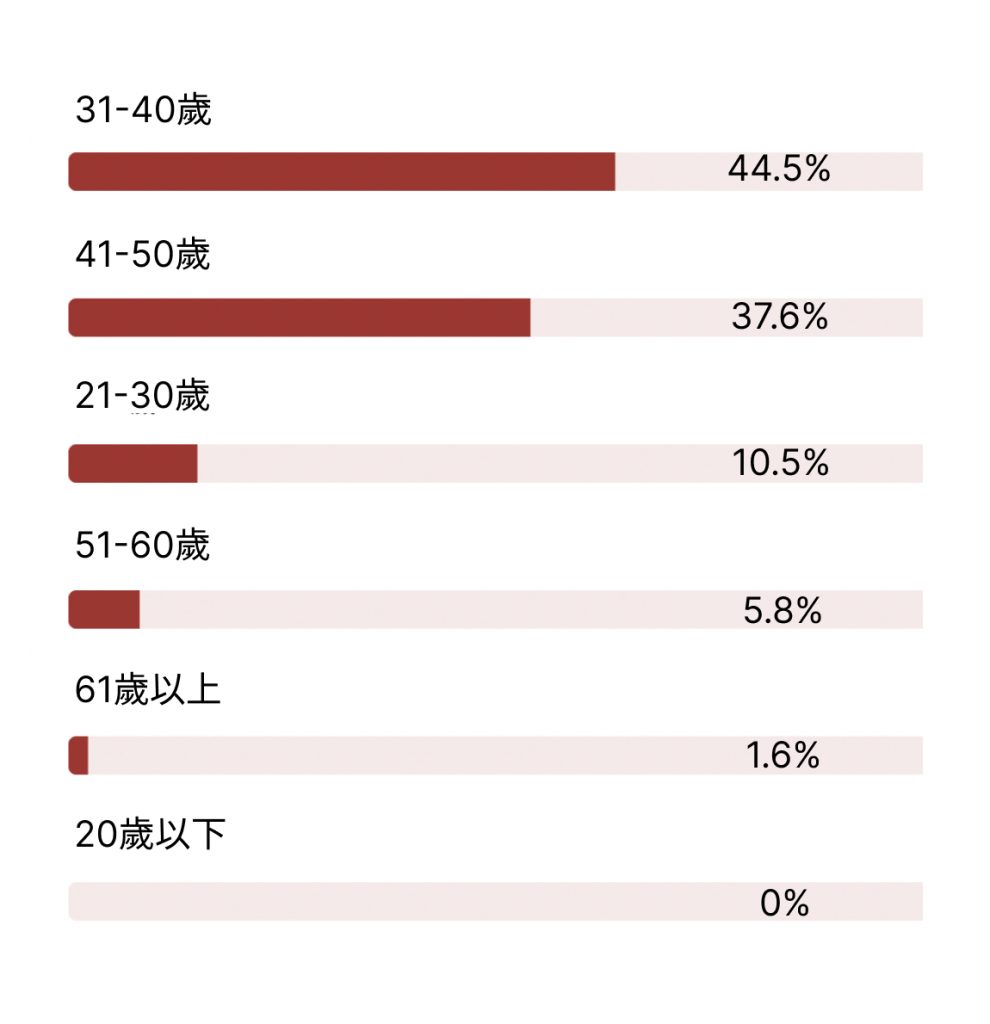
Age
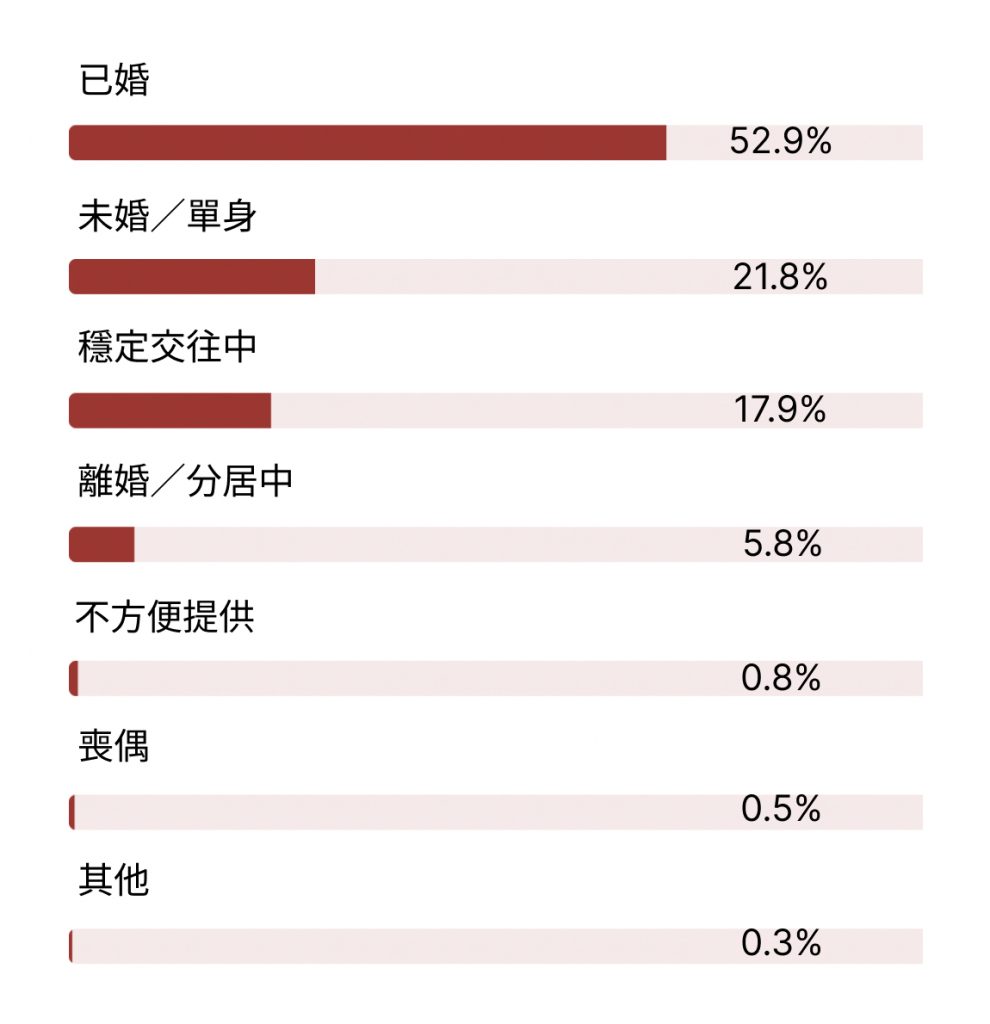
Marital Status
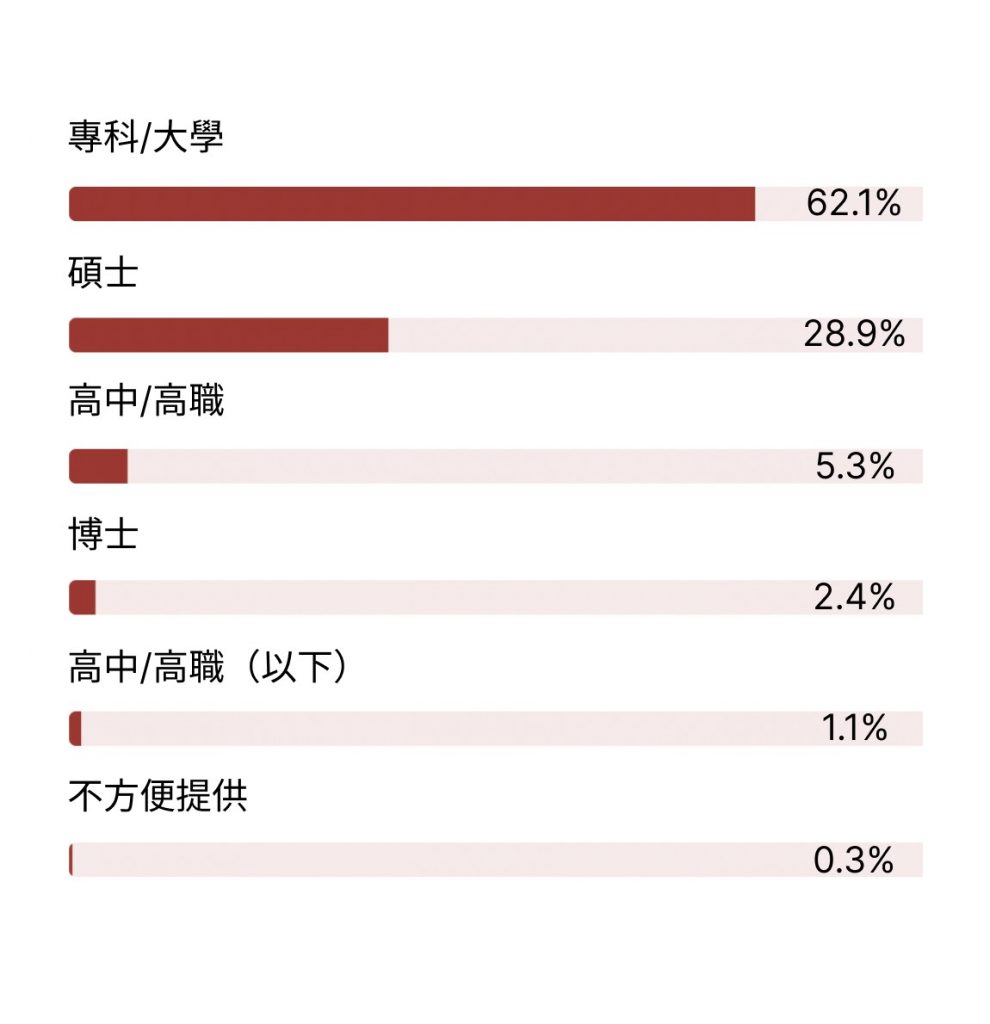
Educational Background
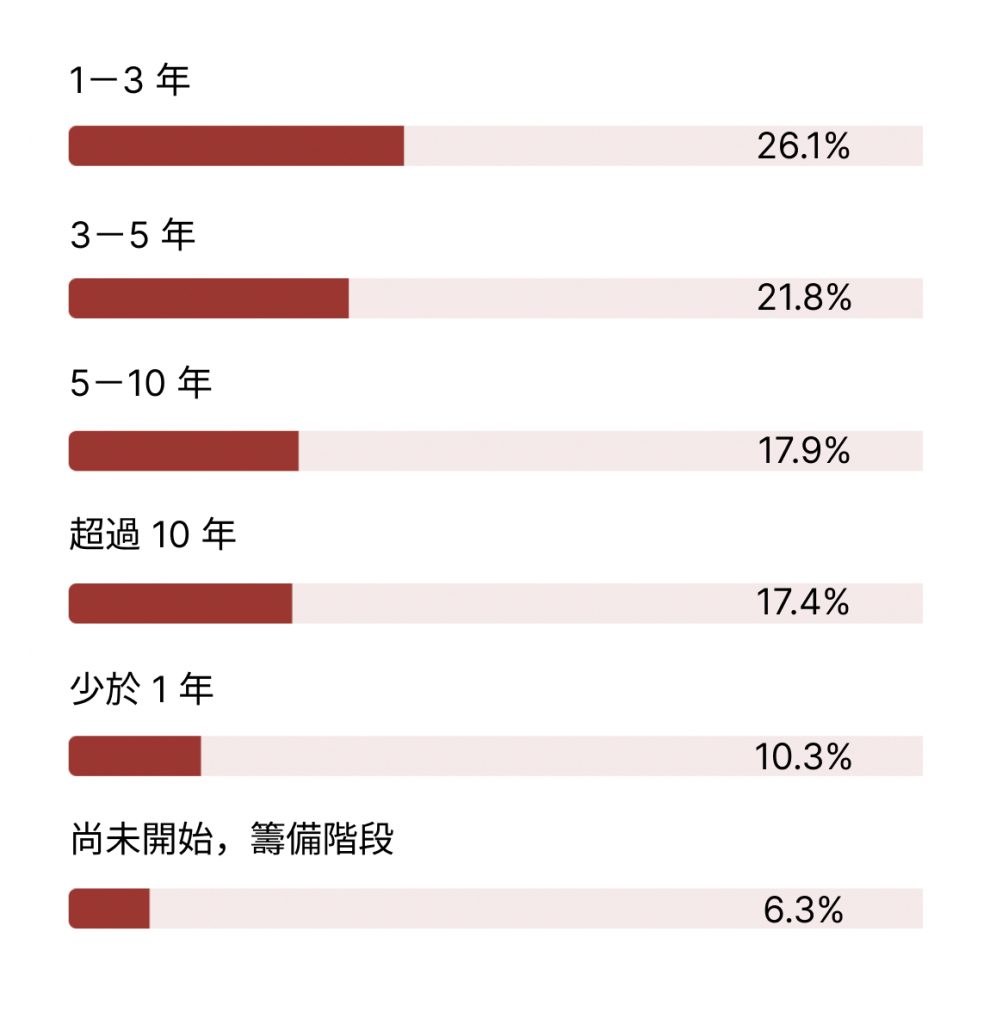
Business Stage
"Micro Business" and "Personal Brand" which is gradually replacing the traditional value of scale in defining business success
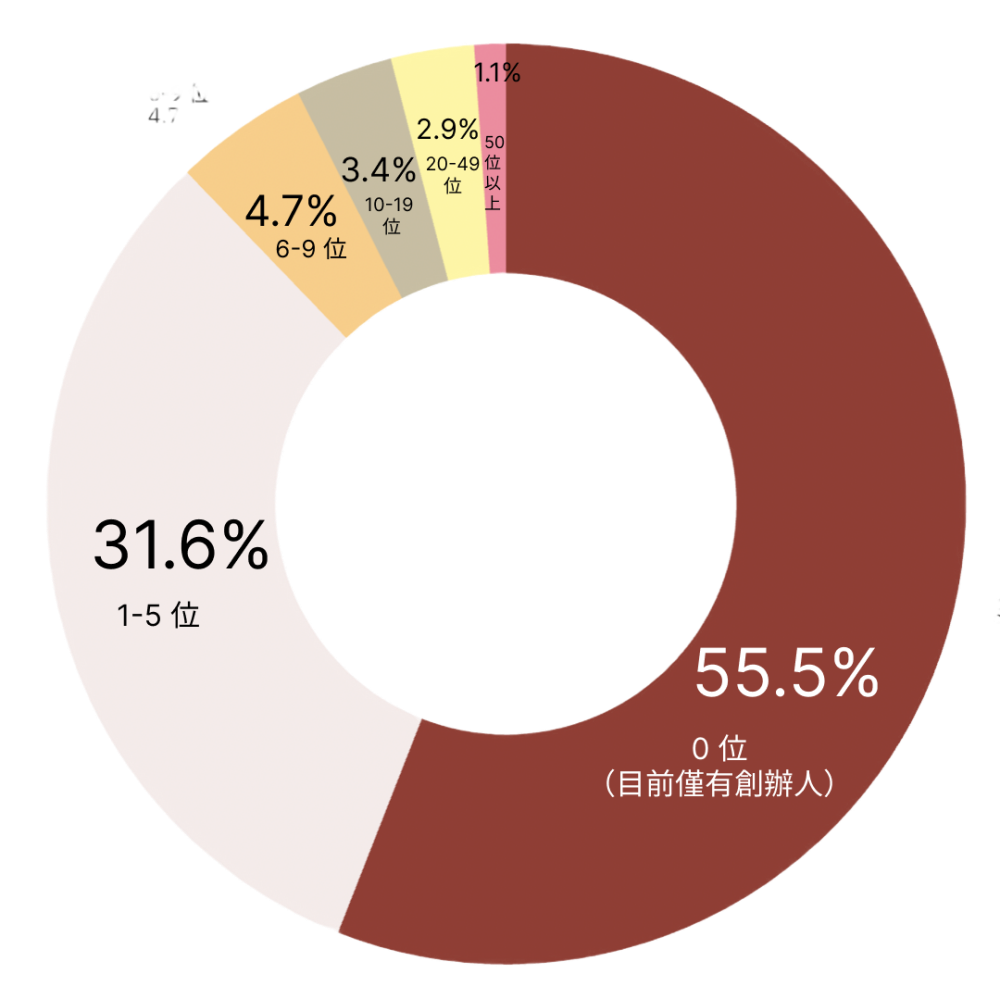
How many paid staff members do you currently have (full-time and part-time)?
With lower barriers to starting a business, solo entrepreneurship is on the rise and is becoming a key part of the entrepreneurial ecosystem.
Structures of organization
are being reshaped
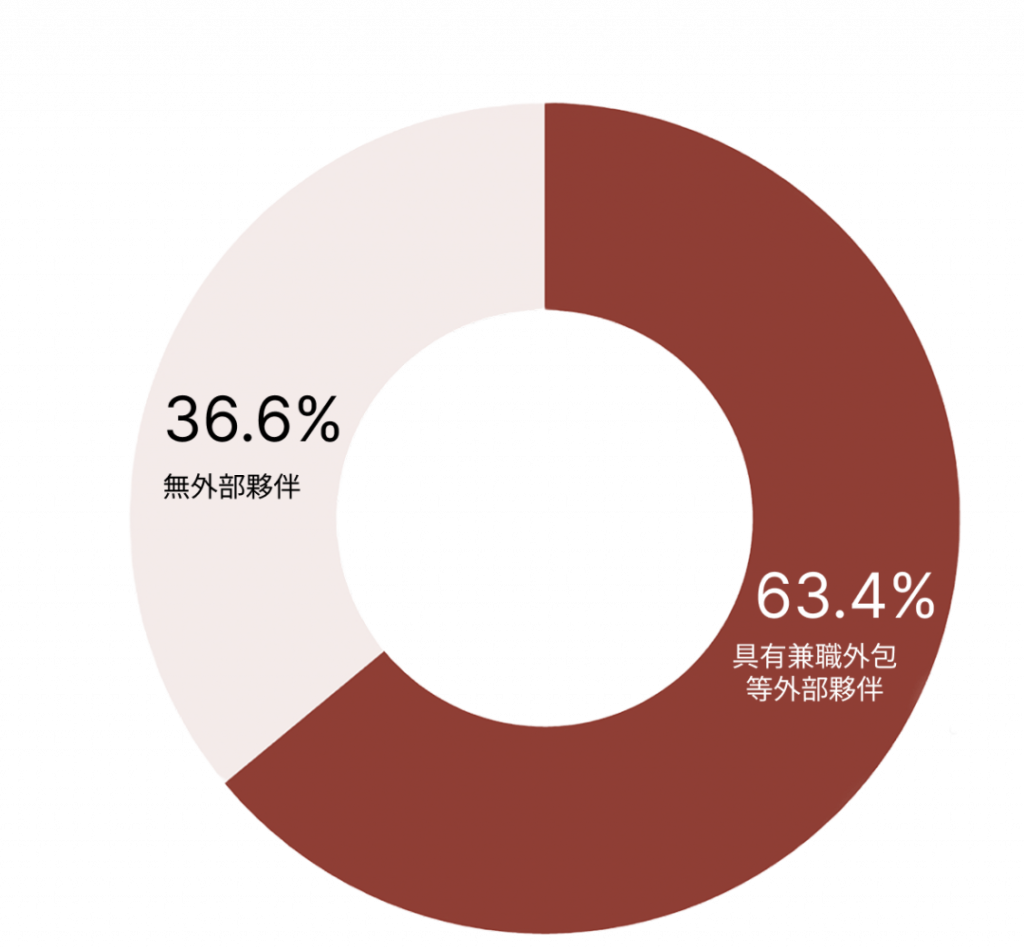
Q: Beyond your internal team members, do you work with long-term external partners such as part-time staff, consultants, or freelancers?
They are no longer bound by fixed offices or conventional employment structures, but are made up of diverse professionals who collaborate flexibly based on the tasks at hand.
The traditional employment model is rapidly shifting towards a new organizational approach centred on collaborative relationships.
is slowly being reshaped by female founders themselves
driving a gentle transformation
台灣的創業環境
正在透過女性自主力量
慢慢推進一場
柔韌而堅定的變革
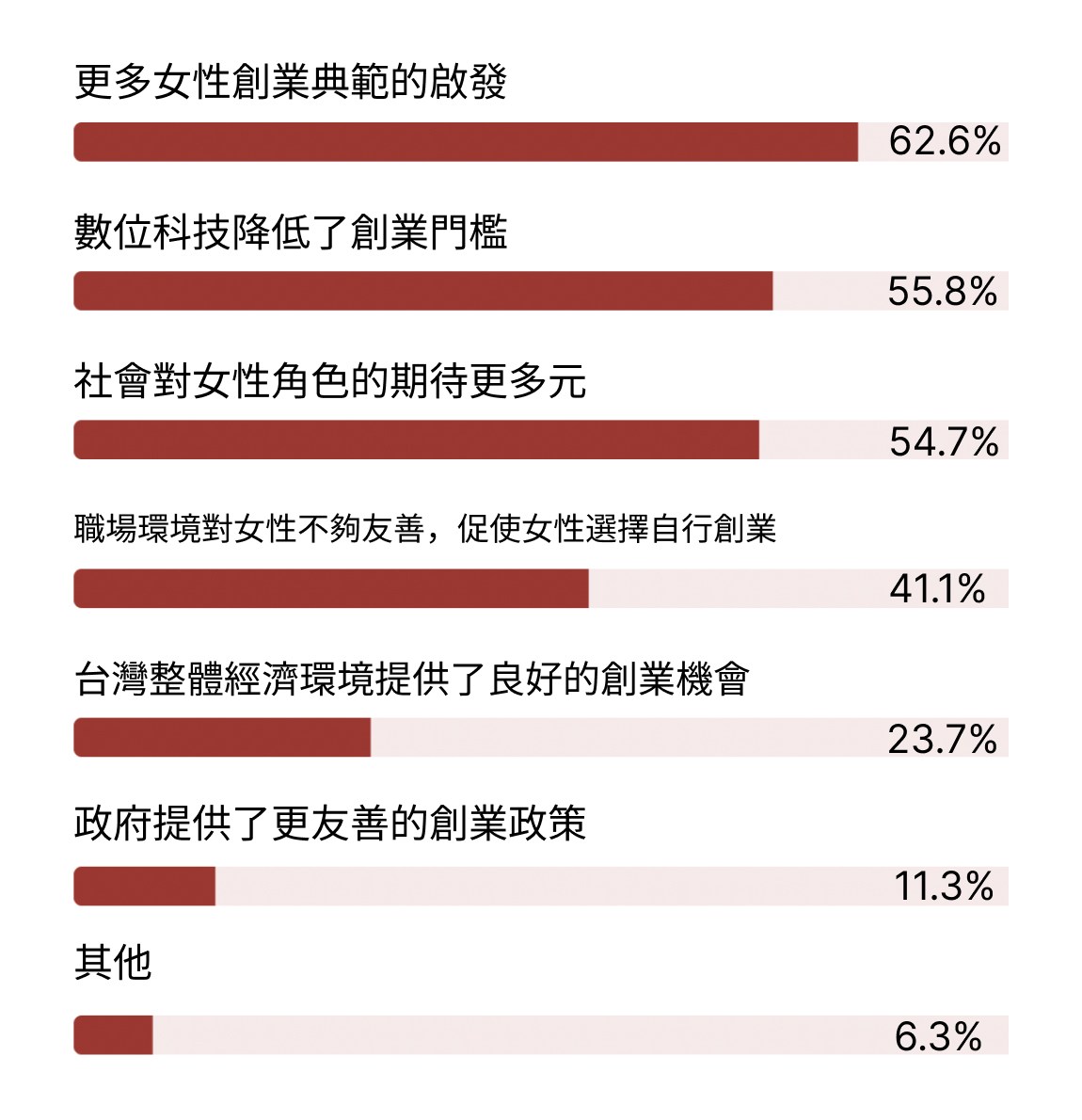
Q: Research shows that the proportion of female entrepreneurs in Taiwan is increasing. What do you think are the main reasons for this trend?
The growth of female founders
is driven by social momentum,
rather than policy.
The survey shows that the motivations behind women’s entrepreneurship are not driven by any single policy or economic condition, but are influenced more by thegrowing awareness of women’s independence。
The majority of respondents indicated that the increase in female entrepreneurial role models and the widespread adoption of digital technologies are the primary drivers, that lowered barriers and making entrepreneurship more accessible to women. Meanwhile, the strong emphasis on “diverse role expectations” suggests that society’s perceptions of women’s roles are gradually shifting, giving women more freedom to pursue entrepreneurship.
In contrast, fewer than25%of respondents cited government policies or the overall economic environment as key drivers.Female entrepreneurship appears to be driven more by bottom-up effortsthan by government policy.
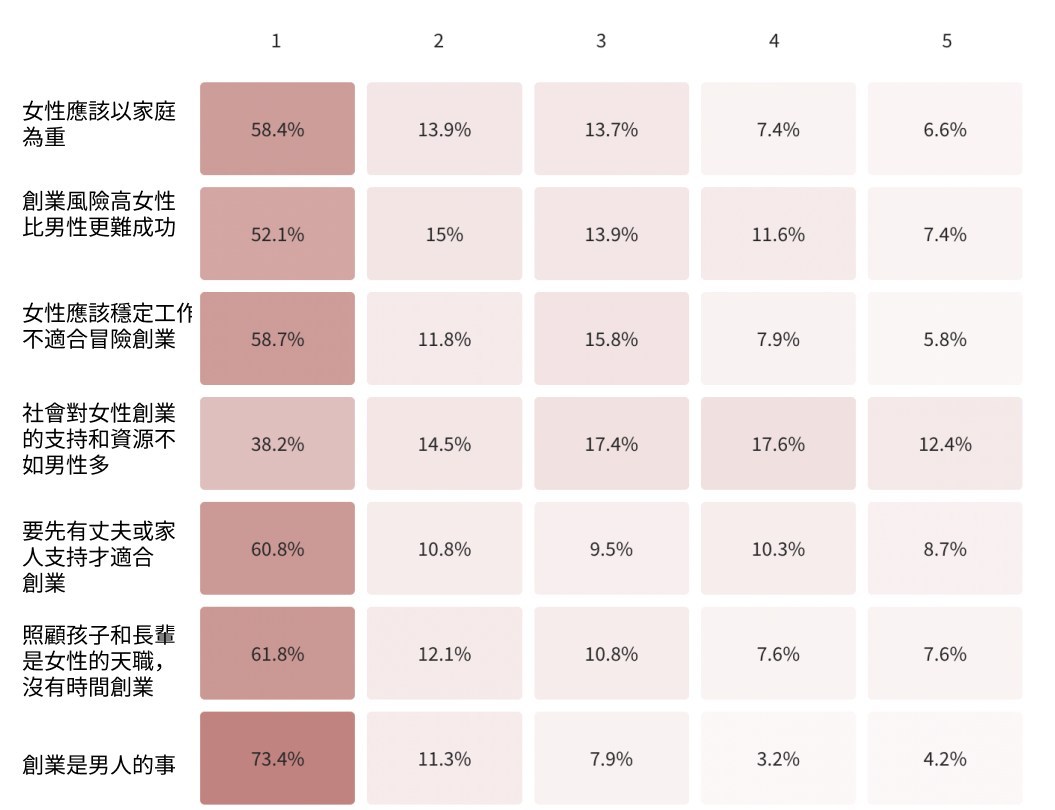
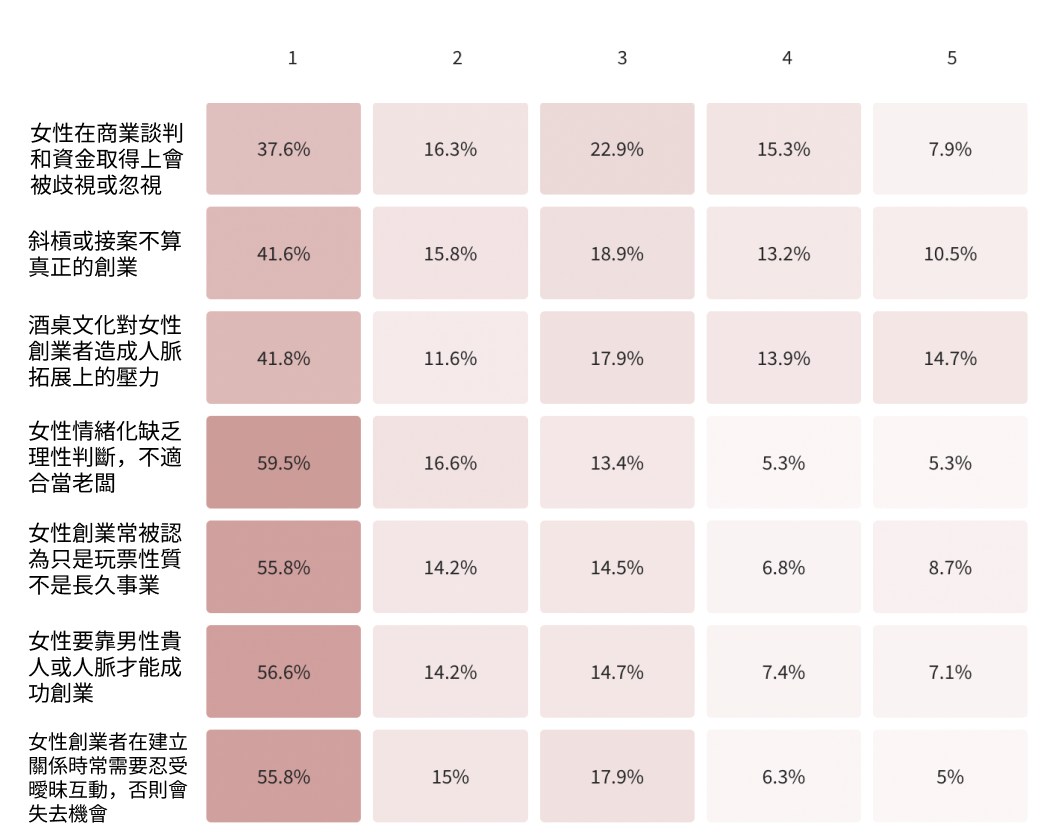
Q: How much impact do the following common cultural norms have on you when starting a business?
The traditional stereotypes of women are no longer the chains restraining female entrepreneurship in Taiwan
For each item measuring gender bias,the highest proportion of responses fell under “1 point (no impact at all),”Among the statements “Entrepreneurship is only for men,” “Women are responsible for caregiving and therefore have no time to start a business,” “Women should have family support before starting a business,” and “Women are too emotional to be good leaders,” over 60% of respondents selected “no impact at all.”
This shows that self-identity and family role–related biases have minimal effect on most female entrepreneurs, who are generally free from traditional constraints.。
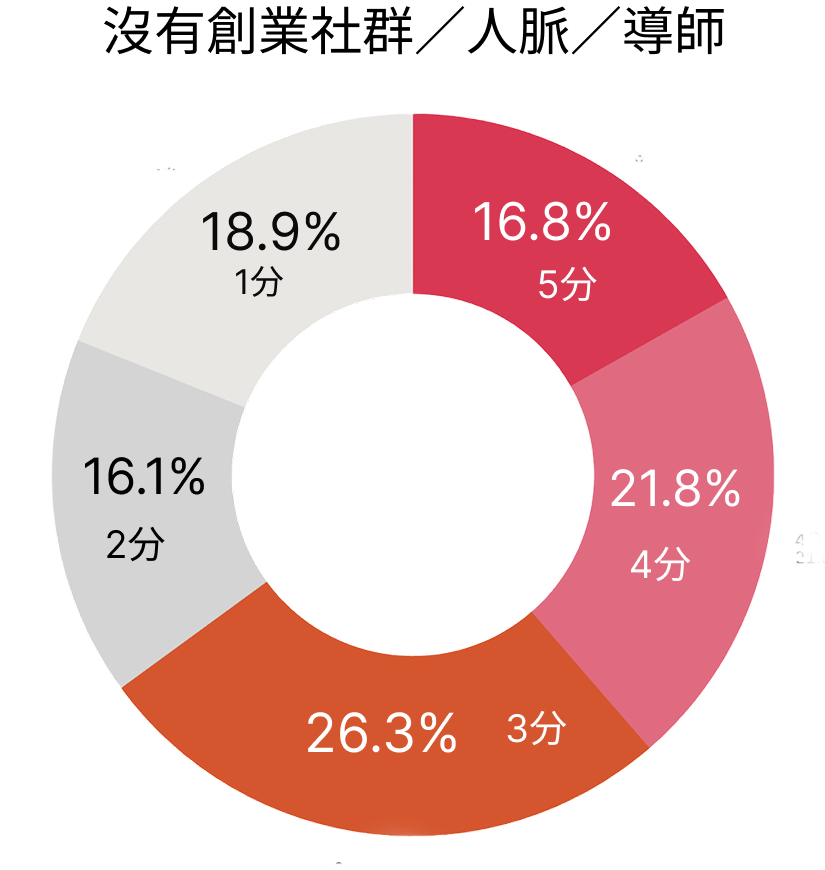
However,When it comes to access to business resources and networking, some women still experience notable bias.Looking at the proportion of 4–5 point responses:
Approximately 28.6% of respondents reported that business drinking culture brings pressure for women entrepreneurs, limiting their participation and networking opportunities.
Approximately 29.9% of respondents indicated that women entrepreneurs receive less support and fewer resources compared to men.
Approximately 23.1% of respondents reported being overlooked in business negotiations and funding opportunities.
Approximately 23.6% of respondents indicated that freelancing or side hustles are often perceived as not real entrepreneurship.
Although women are breaking free from traditional ideas about their personal and family roles,they still face structural barriers when it comes to accessing resources and expanding their networks,emphasising the need for stronger support from policymakers, investors, and other relevant stakeholders.
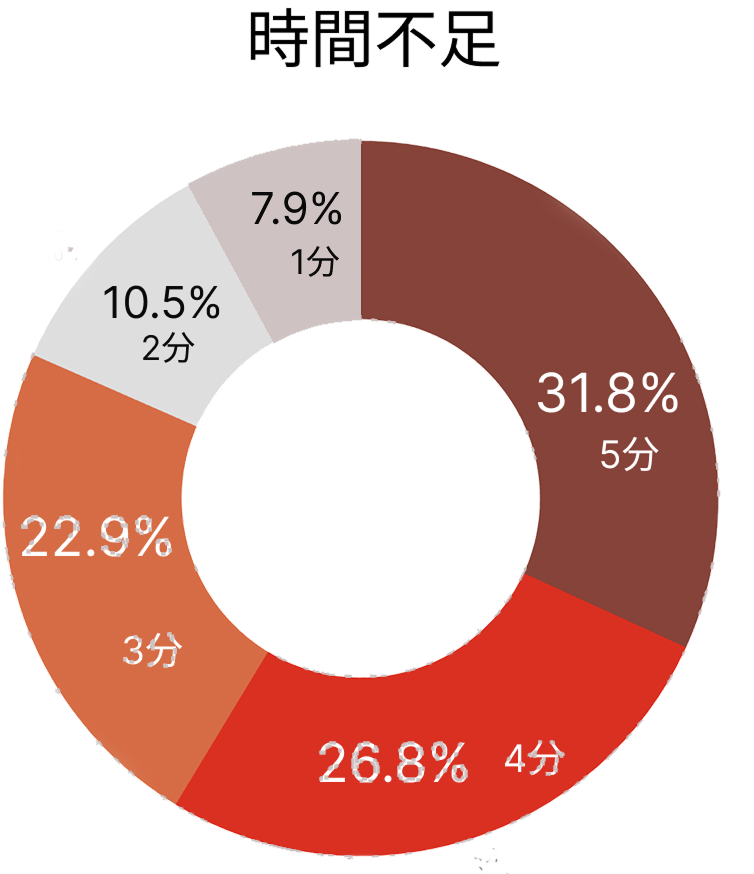
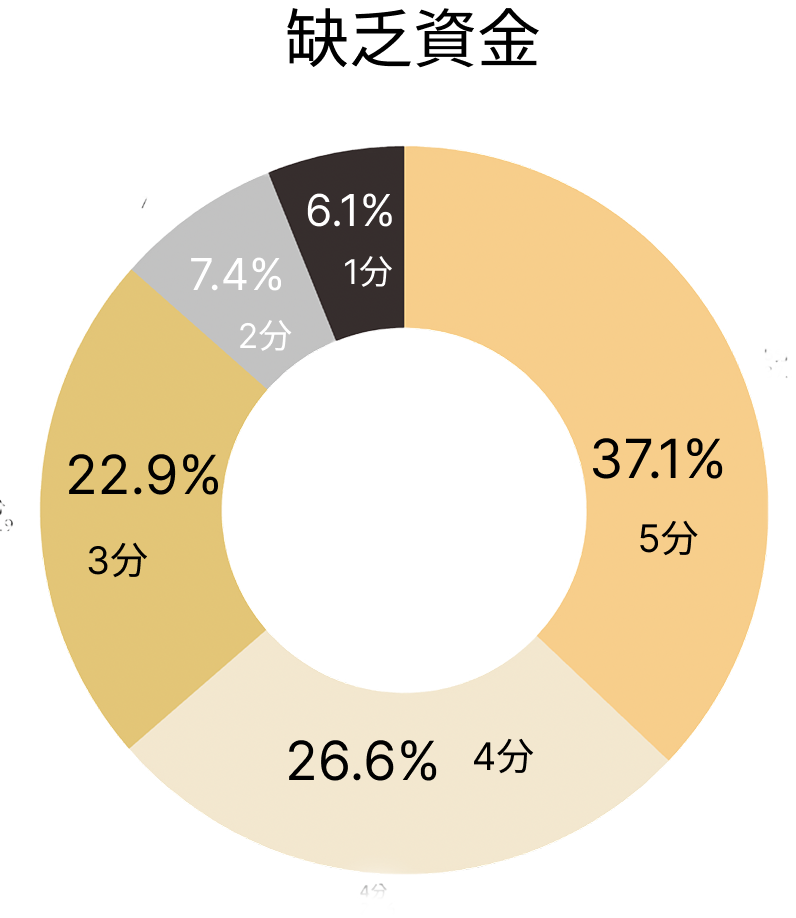
Based on the data from “How challenging are the following factors for you?”ratings of 3 to 5 were high among respondents.This indicates that,even as traditional gender stereotypes gradually diminish, female entrepreneurs still face structural challenges in their operations.difficulty securing funding, limited access to mentorship, exclusion from professional networks.
Entrepreneurship is not only about earning money It is also a way to self-fulfillment and finding meaning in life
創業不只為了錢 更是自我實現 與生活意義的選擇
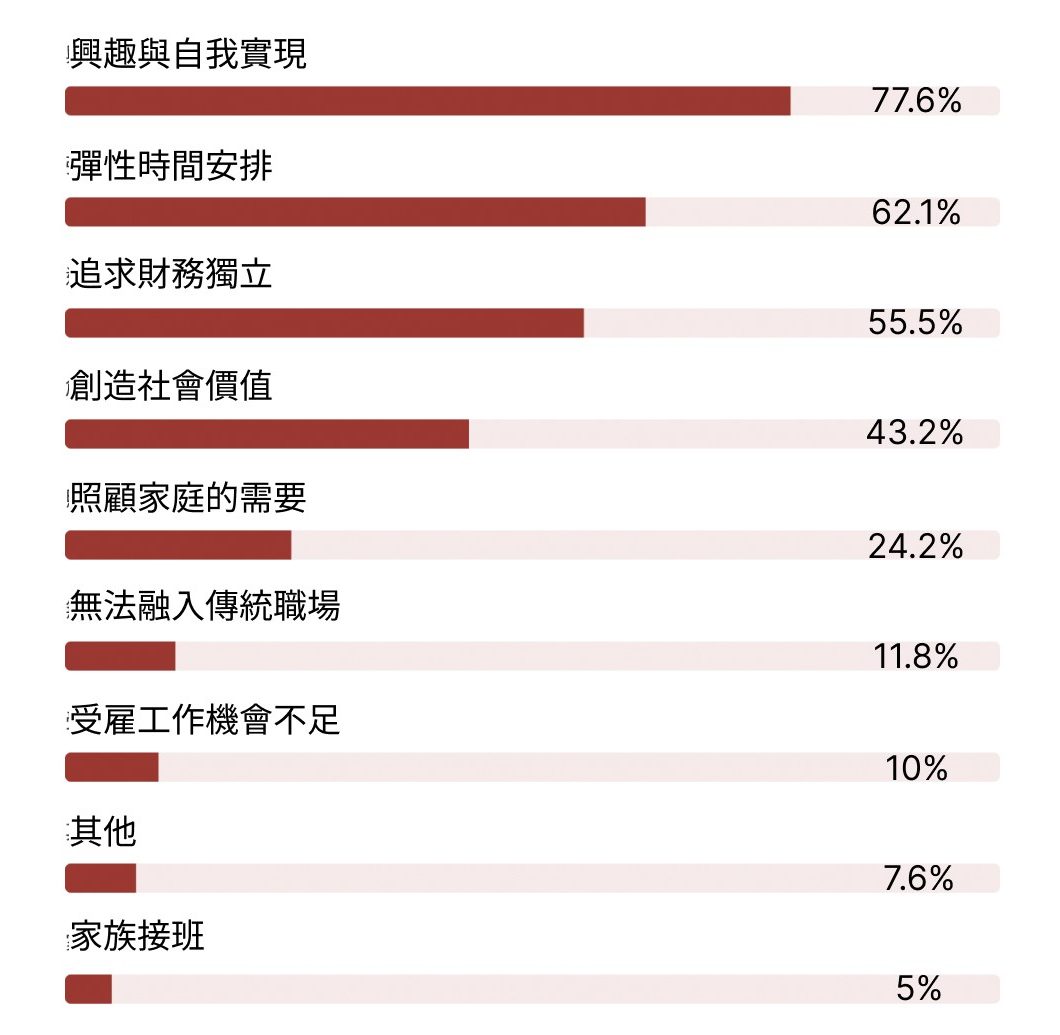
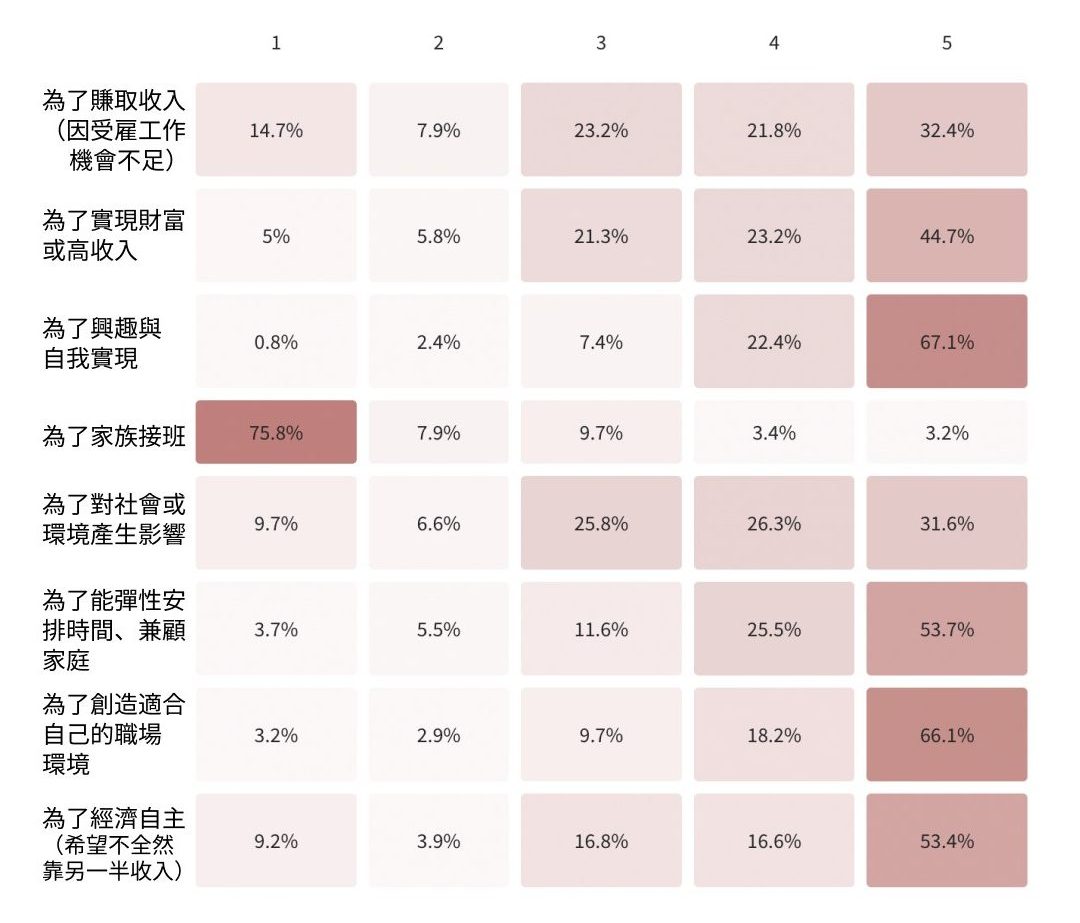
The top three motivations for female entrepreneurs were “interest and self-fulfilment,” “flexible working hours,” and “financial independence.” In the importance ratings, “balancing family and work,” “autonomy in working,” and “personal growth and sense of achievement” also received relatively high scores.
By contrast, “limited employment opportunities” and “difficulty integrating into the traditional workplace” received lower ratings. Overall, the results suggest that a focus on quality of life and self-worth is a key driver of female entrepreneurship.
Overall, most female entrepreneurs in Taiwan are not driven by negative or necessity-based motives, but by positive, self-directed aspirations to create meaningful lives. Entrepreneurship is no longer merely a means of survival, but an active path towards an ideal lifestyle and a sense of self-worth. This also reflects a broader shift that Taiwan is switching from being driven by economic pressure to being guided by personal values and life aspirations.
In response to the question “How do you define success?”, the majority of respondents (49.7%) identified “being happy and feeling accomplished” as the most important indicator, followed by “achieving annual income targets” (40.3%) and “being able to live the life I want” (31.1%). “Flexible working hours” (26.8%) and “work-life balance” (25.8%) were also selected by a significant portion of respondents.
In contrast, external achievements such as “number of employees” or “high media visibility” were rated much lower, suggesting that female entrepreneurs define success primarily through personal well-being and self-fulfillment, rather than organizational scale or external recognition.
Traditionally, success has often been measured by company size, revenue growth, fundraising ability, and other indicators—an “external achievement-oriented” perspective. Compared to this, female entrepreneurs place greater emphasis on internal satisfaction and quality of life. Their definition of success revolves around creating a way of working that allows them to live freely, balance family responsibilities, and achieve self-fulfillment.
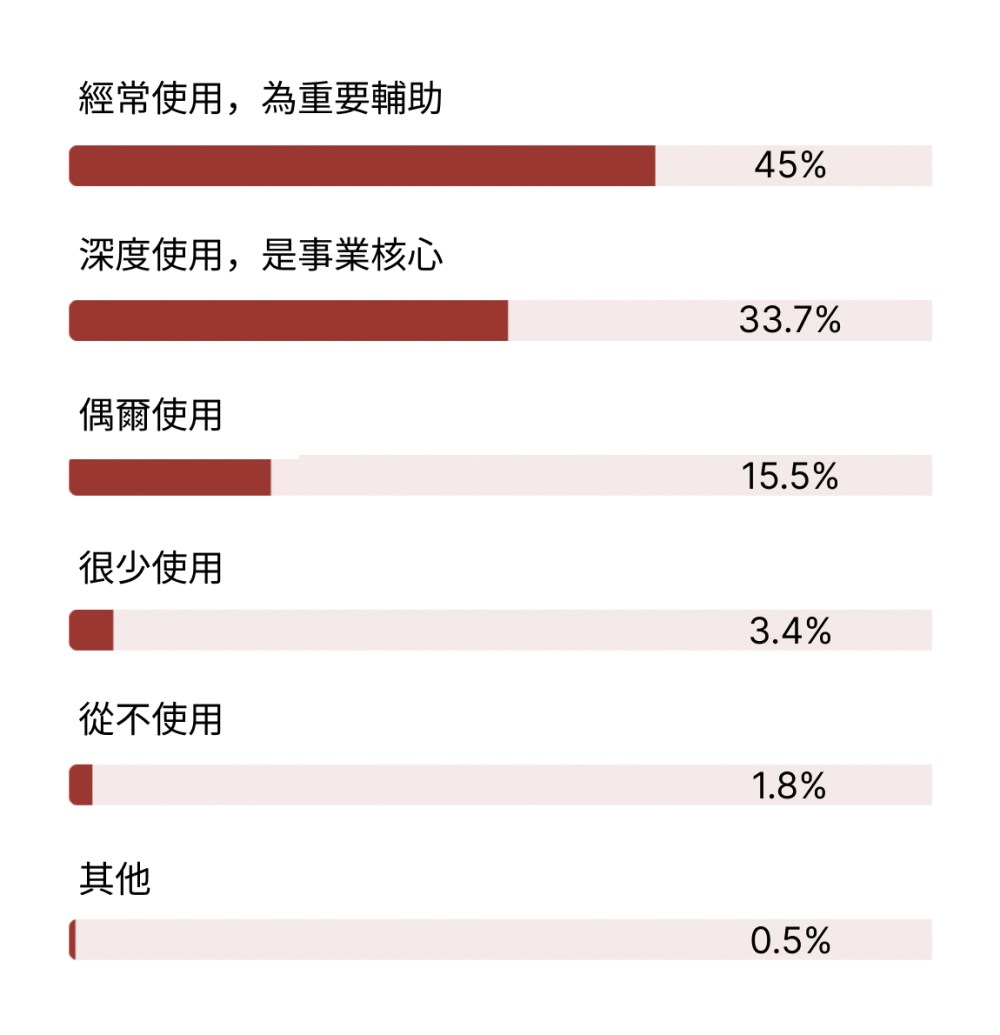
Up to 78.7% of respondents, using digital tools intensively or frequently, include social media marketing, AI, or digital platforms as central or important support in their business operations.
Innovation in Service Design
and User Experience
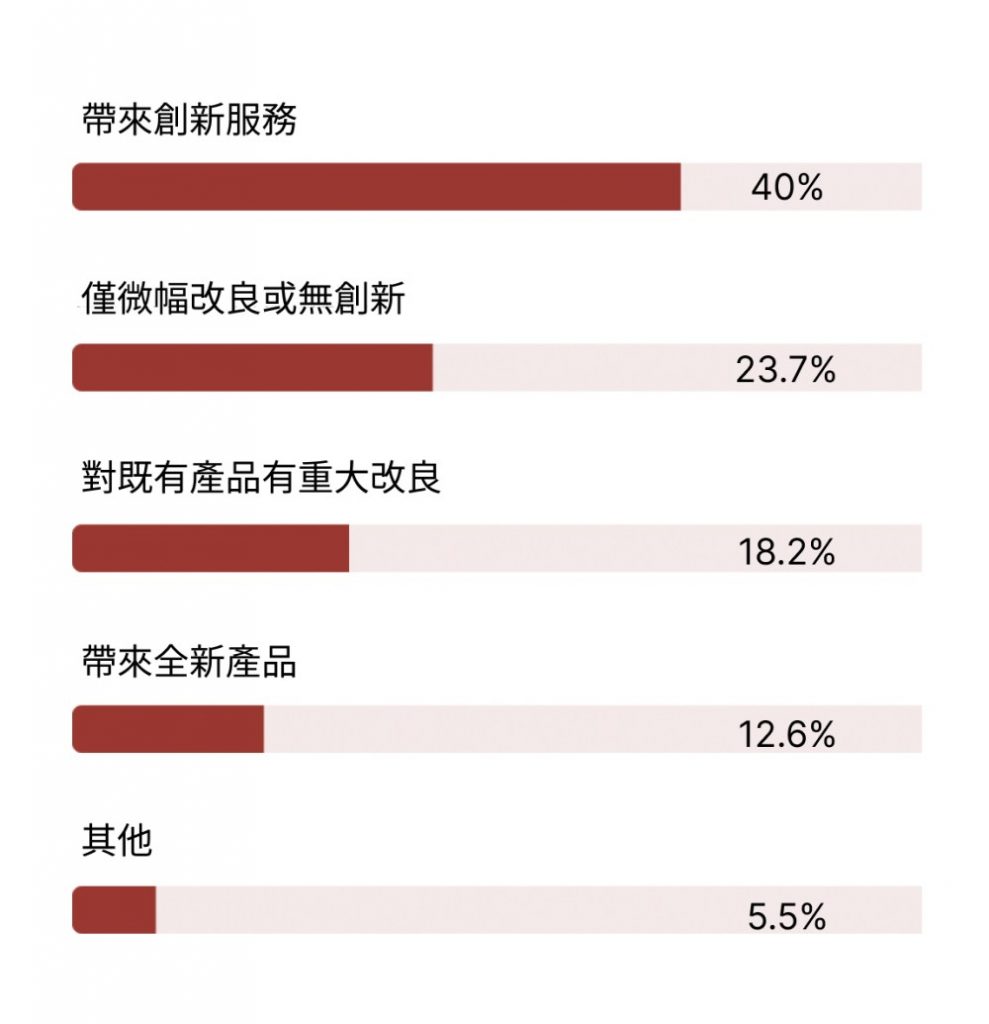
Most female entrepreneurs focus their innovation on service innovation (40%) rather than developing entirely new products (12.6%), indicating that their entrepreneurial approach centres on service design, user experience, and business model innovation, rather than capital-intensive technology or product R&D.
Practicality Meets Sustainability
ESG and Social Value at the Core
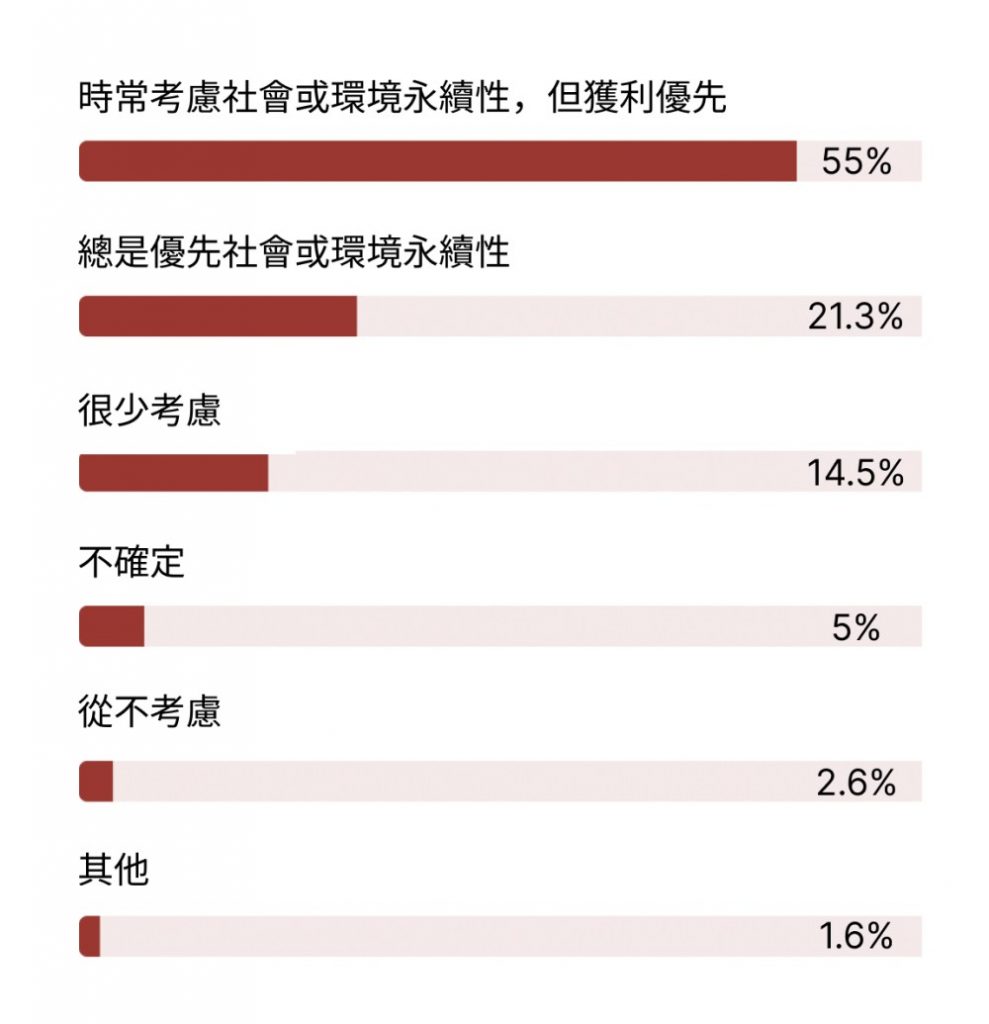
Their business strategies are not solely focued on profit; they aim to balance financial performance with social value or environmental impact. This approach also reflects women’s multitasking abilities and their capacity to consider multiple dimensions.
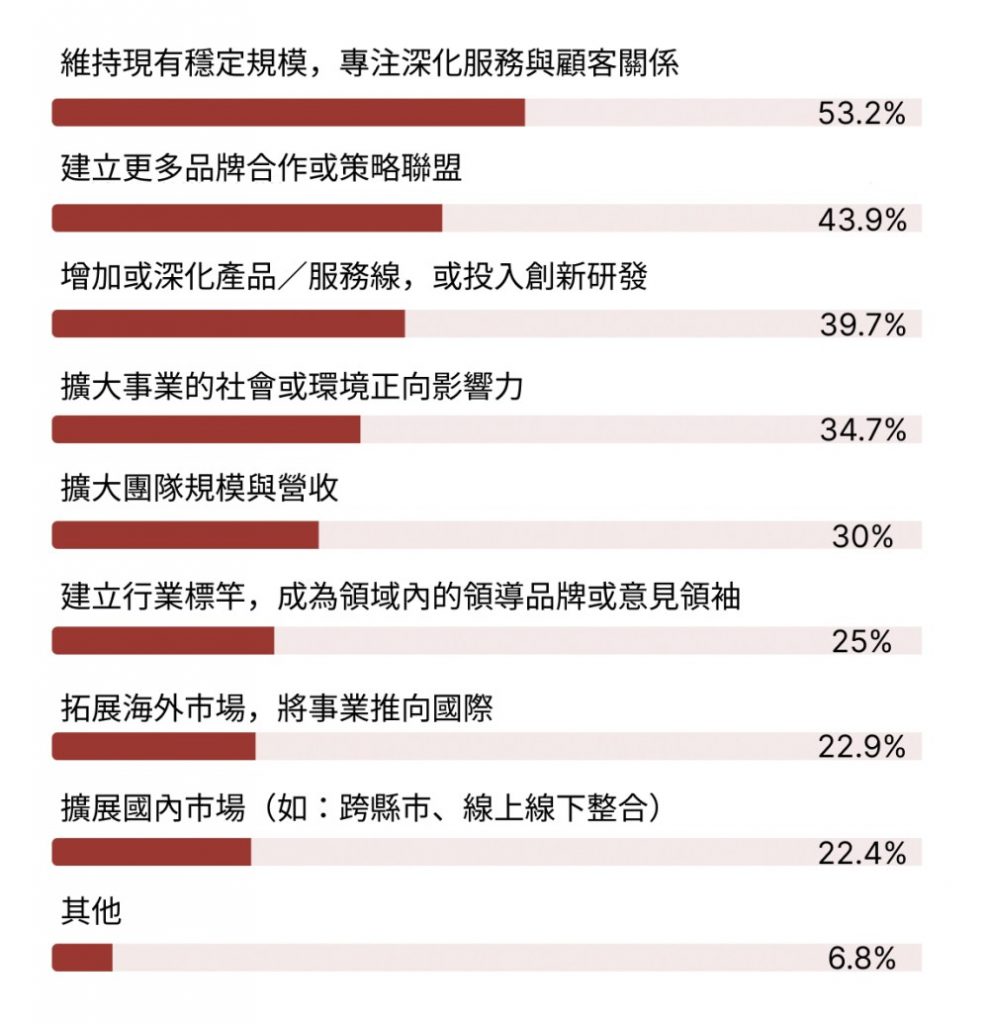
Female entrepreneurs do not see scaling up as the only target; they focus on running their businesses steadily while deepening value. They tend to adopt sustainable, flexible, and relationship-oriented approaches, prioritizing long-term impact and social value, rather than chasing rapid or high-risk expansion.
Key Challenges and Real Experiences of Female Entrepreneurs
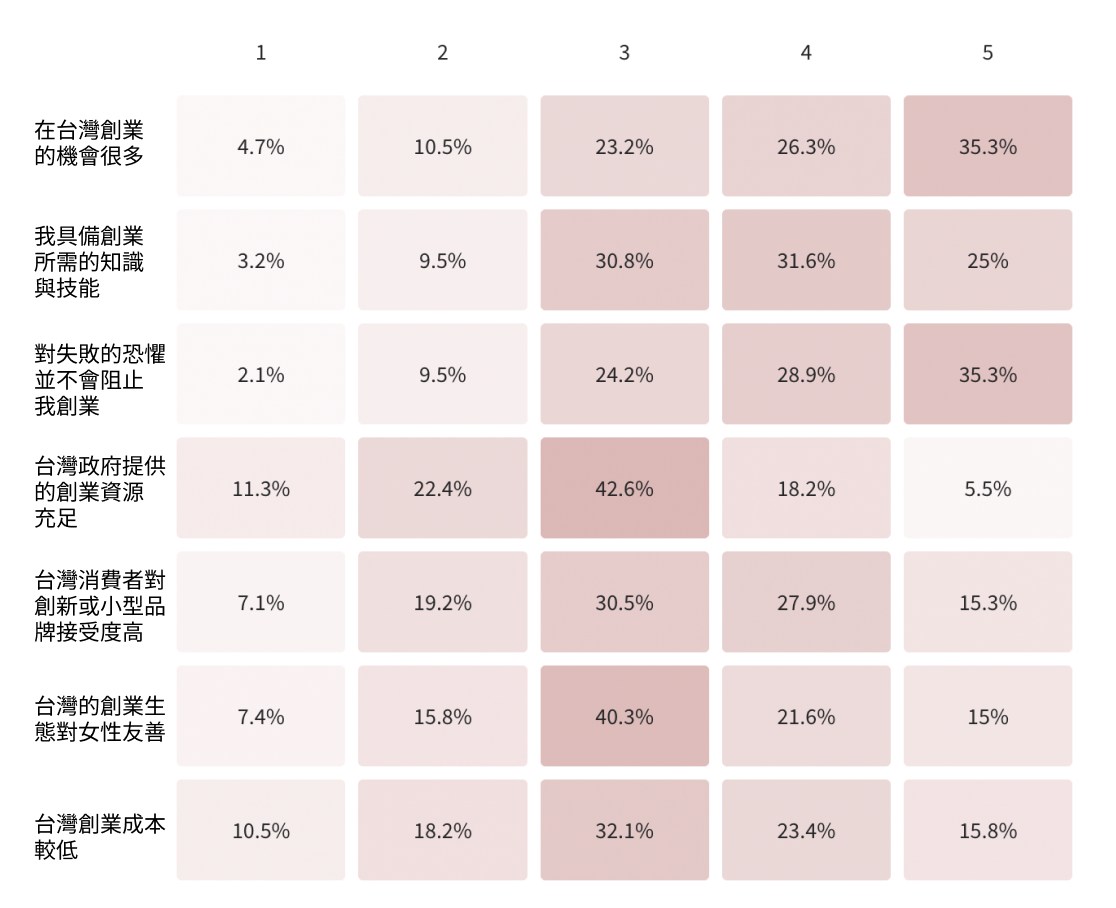
Q: How much do you agree with the following statements about starting a business in Taiwan?
Female entrepreneurs hold a generally positive view of the entrepreneurial environment in Taiwan, though policy and institutional frameworks remain in need of improvement.
Around 35.3% of respondents strongly agreed that “there are many opportunities for entrepreneurship in Taiwan” and that “fear of failure would not stop me from starting a business,” reflecting their high confidence in both their entrepreneurial intent and capability.
However, compared with their strong personal initiative and confidence, their average ratings for “policy support” and “gender-friendly environment” were only around 3 out of 5.
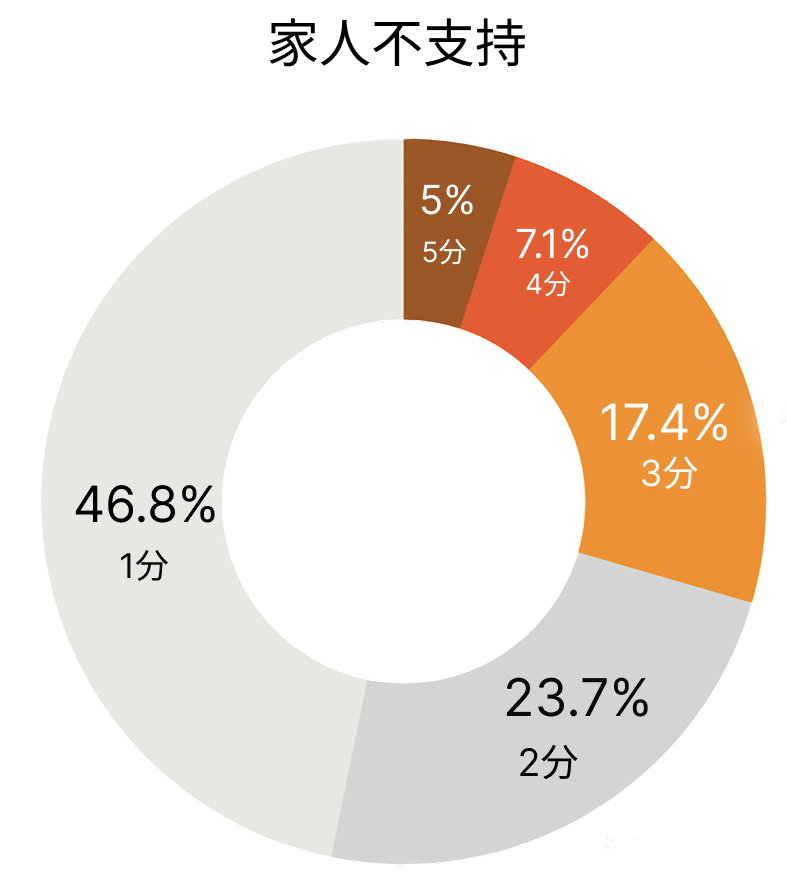
Lack of family support: 46.8% of respondents selected “1” → indicating that most women are not hindered by their family’s opinions.
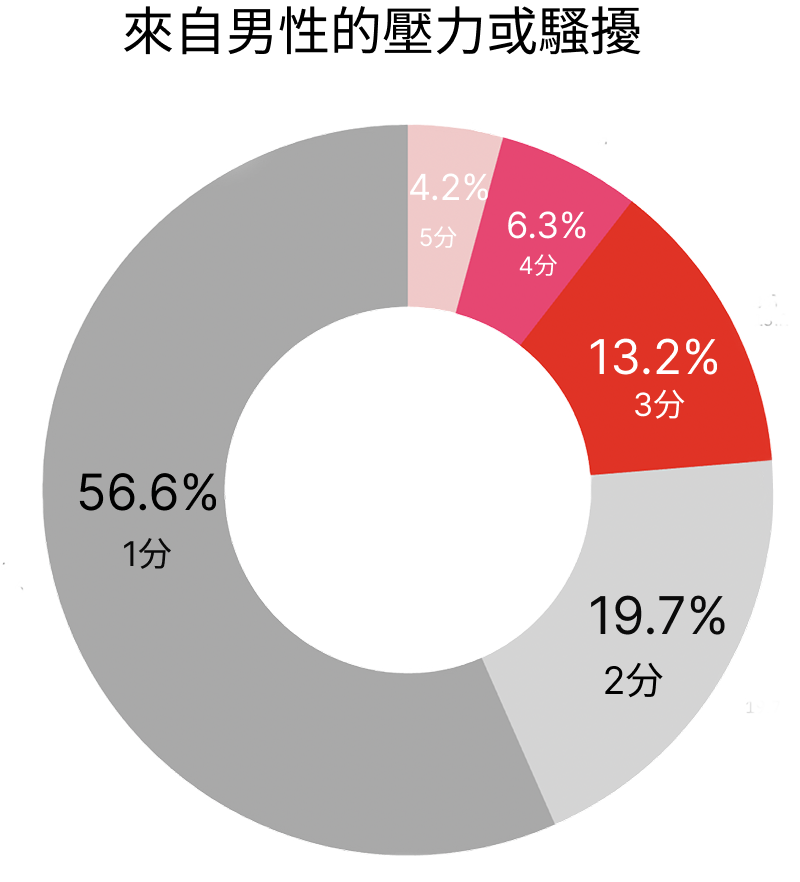
Pressure or harassment from men: 56.6% selected “1” → showing that the majority of women do not consider this a barrier.
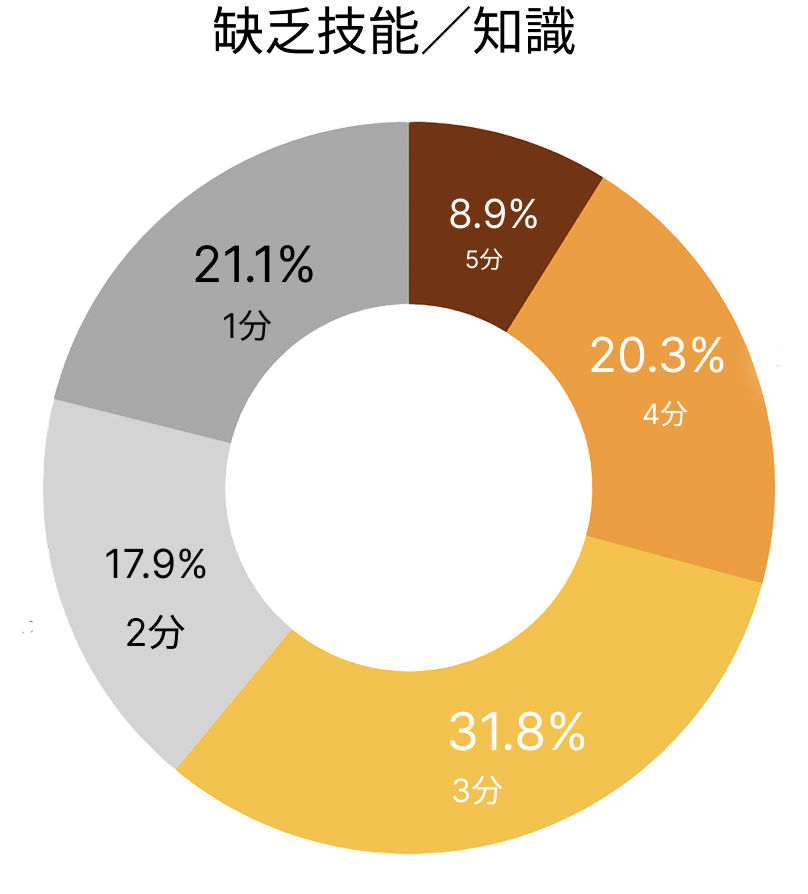
On the other hand, the lack of skills or knowledge showed a highly dispersed response pattern. The proportion of ratings across 1–5 was relatively even, with no single answer dominating, reflecting substantial variation in entrepreneurs’ experiences in these areas.
HER Voices
Formally gender-focused but lacking in substantive support
形式上的女性導向
實質上缺乏針對性
The quality and quantity of community support remain insufficient. Although “female entrepreneurship communities” have continued to grow, their impact and resources are still lower compared to male-dominated entrepreneurial networks.
The startup ecosystem often assumes that entrepreneurs have no family or children and can dedicate themselves full-time, but this is not the reality for many.
The Vocational Training Council has been very helpful for women re-entering the workforce, but follow-up support, such as employment assistance, is virtually nonexistent.
I’ve attended an event organized by another association for female entrepreneurs, but I didn’t feel that the discussion truly addressed issues specific to women in entrepreneurship. It simply selected female speakers and participant.
Women entrepreneurs often choose businesses that address daily needs, such as food and beverage or postpartum care services. However, these types of ventures often find it difficult to access government support or funding.
Available resources are limited by a narrow or rigid approach
Most respondents noted that Taiwan already has support groups, subsidies, and programs for female entrepreneurs, but these supports are largely similar, repetitive, and lack innovation or diversity.
Existing resources tend to be concentrated among those with strong backgrounds, capabilities, or in certain industries (e.g., technology and startups), offering limited support for early-stage or smaller ventures.
ost support still focuses on male-dominated sectors, such as tech and digital products.
There is still a lack of female gender lens communities. At least for now, I haven’t come across any that have both a clear mission and steadily growing resources(or those able to balance both feminine and masculine energies). What I hope for is a community that can support business need and balance social and environmental responsibility, values well-being. If there could be a cross-disciplinary, safe, and purpose-driven business community where people share the same core values that would be something truly beautiful.
Gender bias continues to exist in both visible and hidden forms
Throughout my journey of learning business and marketing, I’ve noticed that most consultants and coaches are men, while successful women tend to be leaders in specific industries rather than mentors who share broader business knowledge. When it comes to developing services or products for women, there are also very few programs specifically designed to address women’s needs. Most simply target female audiences. Gender becomes a default segmentation rather than a thoughtful consideration. This reflects how Taiwan still lacks a comprehensive, end-to-end ecosystem that supports women entrepreneurs from the very beginning.
I’m often overlooked during performances. People seem interested in the male musicians. When I introduce myself as a musician, no one really takes it seriously. It’s only when they find out that I also teach at a university that their attitude suddenly changes.
Many entrepreneurship programs are led by male instructors. Some of them occasionally express gender-biased views that are not supported by data or evidence. But these courses are often required to qualify for startup funding. I often wonder how many participants unconsciously absorb these biases and bring them into the market, replicating the same prejudices.
The hidden barrier of caregiving responsibilities
There are very few “care stations” or support systems for mothers going through the transitional stages of entrepreneurship.
I’ve tried different communities, but most drequire a huge time commitment that I have to sacrifice family life.
You rarely see discussions about how entrepreneurs manage their relationships or balance family roles.
Perceive gender equality has been achieved and resources are sufficient
Entrepreneurs need to set aside their gender labels and see themselves as neutral. Only then can they transform the way they access support and opportunities that is not limited by gender.
There are many mentors, and thanks to the advantages of social media, I can learn from teachers I’ve always admired. But most people may not be as lucky as I am in knowing exactly which mentors they truly need.
Government resources are sufficient, and there are many private business communities, but you need to actively look for them yourself. Most information isn’t readily shared, making it hard to find relevant connections.
I feel that most of the environment is gender-neutral.
There are so many female entrepreneurs, I don’t think women in entrepreneurship are particularly disadvantaged in Taiwan.